By: Adaeze
Sep 13, 2025
False friends: words that sound the same in two languages but mean totally different things
Why that “gift” might not be so giving after all
Do you know that there are similarly existing words that have different meanings? Sounds funny, right?
The world of false friends is both intriguing and deceptive. Words that look or sound like familiar terms in another language, but carry completely different meanings. In fact, they are a linguistic booby trap waiting to trip up travelers, language learners, writers and even fluent speakers. Do not worry. We are here to help you spot the imposters, laugh at the confusion, and walk away a little wiser.
What are “false friends,” exactly?
Linguists call them false cognates or false friends (borrowed from the French faux amis). These are word pairs across two languages that appear similar but don’t mean the same thing.
There are a few reasons these linguistic doppelgängers referred to as “false friends” exist:
- Shared roots/ Historical Drift: Some words come from the same origin (e.g., Latin or Greek) and were adopted by many cultures but evolved and took on different meanings over time.
- Loan words with a twist: Some were borrowed and then redefined in one language.
- Colonialism and trade: Cross-cultural exchanges introduced new meanings, even as pronunciation remained similar.
- Cognitive bias: When learning, we tend to assume that similar-looking or sounding words mean the same thing a mental shortcut that backfires with false friends.
- Coincidence: In many cases, it’s just random chance that two unrelated words sound eerily alike.
No matter how they came to be, false friends can lead to harmless mix-ups or deeply embarrassing ones. Let’s explore some of the most notorious examples.
15 false friend pairs that might trick you
Here’s a breakdown of misleading word pairs from around the world. For each one, we’ve included the false friend, its true meaning, and the potential misunderstanding it might cause.
1. Gift (english) vs. Gift (german)
- English: A present.
- German: Poison..
Scenario: Imagine cheerfully telling a German speaker you have a gift for them. yikes.
2. Embarazada (spanish) vs. Embarrassed (english)
- Spanish: Pregnant.
- English: Ashamed.
Scenario: Telling someone you're “embarazada” after spilling wine on yourself might raise some eyebrows.
3. Library (english) vs. Librairie (french)
- English: A place to borrow books.
- French: A bookstore.
Scenario: You’re in Paris trying to find a quiet place to study, and you end up in a checkout line instead.
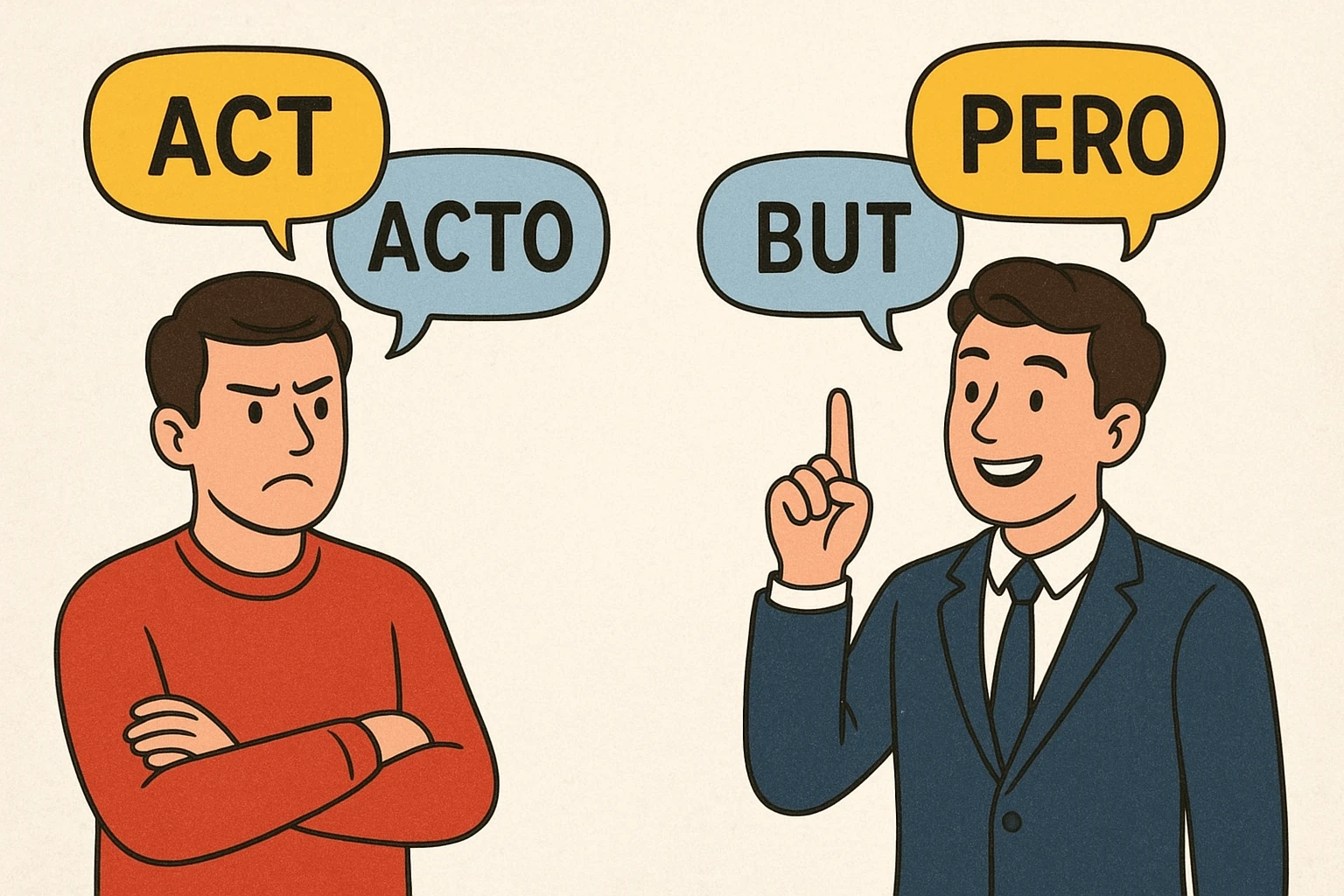
4. Actual (english) vs. Actuel (french)
- English: Real or true.
- French: Current or up-to-date.
Scenario: You say “the actual problem,” and your French listener thinks you're referring to something recent.
5. Chef (english) vs. Szef (polish)
- English: Head cook.
- Polish: Boss or manager.
Scenario: If a polish coworker refers to the “szef,” don’t expect culinary advice.
6. Pasta (english) vs. Pasta (portuguese)
- English: Noodles.
- Portuguese: Folder.
Scenario: You're visiting Brazil and someone ask for pasta, and you proudly hand them a plate of appetizing spaghetti. They stare at you, confused, because they were expecting a folder not dinner!
7. Rope (english) vs. Rop (swedish)
- English: Cord or string.
- Swedish: A shout or call.
Scenario: Don’t ask someone to hand you a “rop” while sailing in Sweden they may yell at you.
8. Sensible (english) vs. Sensible (spanish/french)
- English: Reasonable, practical.
- Spanish/French: Sensitive or emotional.
Scenario: Calling yourself “sensible” in Spain might make people think you cry during shampoo commercials.
9. Assistir (portuguese) vs. Assist (english)
- Portuguese: To watch (a movie, event).
- English: To help.
Scenario: You offer to assist someone in Brazil, and they think you're inviting them to Netflix.
10. Parents (english) vs. Parentes (italian)
- English: Mother and father.
- Relatives in general.
Scenario: You tell an Italian friend your parents are visiting, and they assume your whole extended family is flying in.
11. Sympathetic (english) vs. Sympathique (french)
- English: Understanding, emotionally supportive.
- French: Nice or likable.
Scenario: Saying your coworker is sympathique doesn’t mean they’re helping you through tough times it just means they’re friendly.
12. Pretend (english) vs. Prétendre (french)
- English: To fake or imagine.
- French: To claim or assert.
Scenario: A French speaker who says, “I prétend this is mine,” isn’t role-playing they're stating a claim.
13. Fabrik (german) vs. Fabric (english)
- German: Factory.
- English: Textile material.
Scenario: You’re expecting soft cotton, and instead, you get a tour of an industrial plant.
14. Magazine (english) vs. Magazin (russian)
- English: Periodical publication.
- Russian: Store or shop.
Scenario: A Russian says they’re going to the magazin they're shopping, not catching up on the news.
15. Lecture (english) vs. Lecture (french)
- English: Educational talk.
- French: Reading (as in the act of reading).
Mix-up moment: Your French friend says they had a “great lecture” over the weekend you assume a professor, not a novel.
Tips to avoid false friend fails
Words can be very tricky. The best way to avoid confusion is to have a solid understanding of them. Trust me, these verbal traps are easier to spot once you know they exist. Here are a few smart strategies:
- Double-check in context: Don’t rely on one-to-one translations. Look at full sentences and local usage.
- Use reliable bilingual dictionaries: Not all online translators catch nuance some even reinforce false friends.
- Practice with native speakers: They’ll spot your mix-ups and help correct them early.
- Create your own “false friends” list: Keep a running list of tricky pairs as you learn.
- Read in your target language: Newspapers, blogs, and books offer real-world examples that help words make sense naturally.
The takeaway: trust, but verify
False friends strongly make up part of the beauty and comedy of multilingual communication. However, they exist to remind us that language is fluid, cultural, and full of personality. While they may lead to confusion or embarrassment at that moment, they often create the kinds of stories you'll be telling for years.
So, do not be in a hurry to use words in another language. It may have a different meaning from what you are used to. When next you feel confident using a familiar-sounding word abroad, remember: it might not mean what you think it means. Life is full of surprises, isn't it? When in doubt, ask, pause, or Google with caution. Your credibility and your dignity might thank you.
Over to you
Have you ever fallen victim to a false friend? Share your story in the comments we’d love to hear how language surprised you.